The ZyG Blog
The ZyG Blog
The ZyG Blog

AI Is No Longer the Advantage. The System Is
AI Is No Longer the Advantage. The System Is
AI Is No Longer the Advantage. The System Is
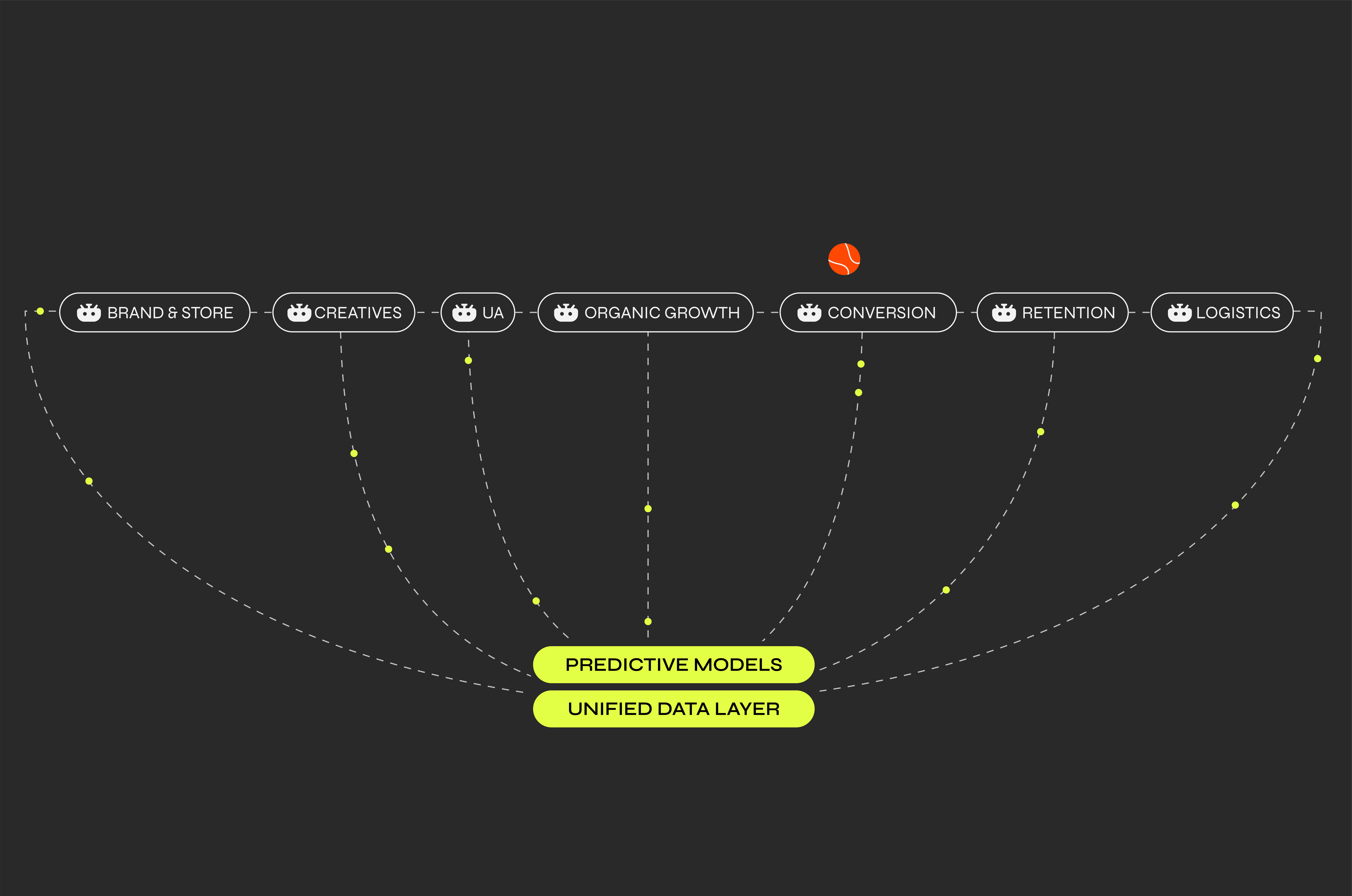
Over the past few years, artificial intelligence has moved from a breakthrough technology to a widely used tool. But as AI tools proliferate, a new reality emerges: Deploying an AI model or agent is no longer enough to create a meaningful advantage. The real value lies in something deeper: how AI agents are structured, how they communicate with one another, and how they are informed by data. It is no longer about the AI agents, but rather about the system that connects them.
The Limits of Isolated AI
Today, most brands and products use AI-driven tools. But these are almost always deployed in isolated pockets. Marketing teams use AI to generate creatives or optimize advertising campaigns. Customer support may introduce AI chatbots to handle common inquiries.
These agents typically operate independently, and this lack of connection to the rest of the growth machine creates a fragmented intelligence layer. An AI agent generating creatives rarely “has visibility” into what is working and what isn’t once the creatives are deployed in campaigns, a retention model does not get the signals generated during the acquisition phase, and pricing decisions are made without a clear understanding of the long-term value of the customers being acquired.
In these environments, AI functions primarily as a collection of automation tools, making tasks much faster and more efficient. But as each tool optimizes its own local objective, the system as a whole does not truly improve.
What emerges is efficiency without coherence. Tasks become faster, but the organization does not become fundamentally smarter.
Why AI Agents Must Be Connected
The real promise of AI begins to emerge when agents are not deployed in isolation but connected across the entire customer journey. When agents share signals and context, the system evolves from a set of independent tools into an integrated intelligence layer that makes better decisions. In a connected architecture, signals from one part of the customer journey can inform decisions everywhere else. A few examples:
Collaboration between Creative and UA Agents: Many brands are now generating creatives via AI solutions, with the goal of creating increasingly realistic videos and imagery. But the strength of an ad is not in how realistic it is, but in how well it converts users. If your Creative Agent works in a silo, you may well wind up with very realistic ads, but they may not be the most effective. In contrast, if your Creative Agent is in communication with your UA Agent, you know right away which ads - regardless of how realistic they are - are your best converters and focus on those.
Collaboration between Customer Service and UA Agents: The Customer Service Agent gets consumer complaints (but rarely praise…) and can flag negative feedback on a specific promise or message made in an ad, which can immediately translate into the removal, or iteration, of the problematic ad.
Collaboration between UA and Logistics Agents: A brand’s advertising should be responsive to the reality of the physical products that need to be shipped. In a connected AI network, the Logistics agent “informs” the UA agent once restocking is complete, making sure advertising dollars aren’t lost on unhappy customers who aren’t getting their deliveries due to lack of stock.
When these signals circulate across the system, each interaction contributes to a broader understanding of the business. Instead of optimizing isolated tasks, the system continuously refines the entire growth engine.
This is the difference between automation and intelligence. Automation simply executes tasks more efficiently. A connected system, by contrast, learns from every signal and improves its decisions over time.
The Importance of a Unified Data Layer
For this kind of connected intelligence to function, all agents must operate from the same foundation. That foundation is a unified data layer that serves as a single source of truth across the entire customer journey.
In most organizations, however, data is scattered across numerous platforms and tools. Marketing systems track advertising performance, e-commerce platforms capture purchase behavior, CRM tools store customer relationships, and support platforms record user issues and feedback. Each system generates valuable information, but these signals are often fragmented and difficult to reconcile.
Without a unified data layer, AI agents operate with partial visibility. They can optimize within their narrow domain, but they cannot see the full context required to make truly intelligent decisions.
A unified data layer provides that shared context. It connects signals from creatives, acquisition, conversion, retention, support, and logistics into a consistent and reliable foundation that every agent can access. When all agents operate on the same underlying data, insights generated in one part of the system can inform decisions everywhere else.
The result is not simply better reporting or analytics. It is a shared intelligence framework that allows the entire system to evolve in a coordinated way.
Why Predictive Modeling Matters
Even with connected agents and a unified data layer, intelligence still requires the ability to look forward rather than merely react to the present. This is where predictive modeling becomes essential.
Many critical growth decisions depend on outcomes that unfold over time. In direct-to-consumer businesses, for example, the profitability of a customer is often determined months after the initial acquisition. Optimizing purely for immediate signals can therefore lead to decisions that undermine long-term performance.
Predictive models allow the system to account for these delayed outcomes: Lifetime value (LTV) forecasting helps determine how much can be spent to acquire a customer while remaining profitable. Cohort analysis reveals which acquisition channels generate the highest-value users over time. Churn prediction enables proactive retention strategies, while demand forecasting helps align inventory and supply chains with expected growth.
These models extend the intelligence of the system beyond the present moment. Instead of reacting to short-term signals, the system can make decisions that maximize long-term outcomes.
Vertical AI: From AI Tools to Intelligence Systems
As AI becomes more widely available, the industry conversation often centers on capabilities: faster models, more sophisticated agents, or new automation features. Yet the real transformation is architectural rather than technological.
Companies that succeed in the coming decade will not simply be those that adopt AI tools. They will be those that benefit from integrated intelligence systems in which agents are connected across the entire customer journey, data flows through a unified layer, and predictive models guide decision-making.
In such systems, every interaction generates a signal, and every signal strengthens the models that guide future actions. Over time, the entire platform becomes smarter, more adaptive, and more efficient. This is what creates a compounding intelligence loop. The system does not merely automate tasks, it continuously improves the way growth decisions are made.
The New Question
For many years, the key question companies asked about technology was simple: Do we have AI?
Today, that question is becoming less meaningful. AI capabilities are increasingly accessible to everyone, and deploying individual agents is no longer difficult.
The more important question is whether AI operates as part of a connected system that learns across the entire business. In the next era of digital growth, AI itself will not be the differentiator. The system is.
Over the past few years, artificial intelligence has moved from a breakthrough technology to a widely used tool. But as AI tools proliferate, a new reality emerges: Deploying an AI model or agent is no longer enough to create a meaningful advantage. The real value lies in something deeper: how AI agents are structured, how they communicate with one another, and how they are informed by data. It is no longer about the AI agents, but rather about the system that connects them.
The Limits of Isolated AI
Today, most brands and products use AI-driven tools. But these are almost always deployed in isolated pockets. Marketing teams use AI to generate creatives or optimize advertising campaigns. Customer support may introduce AI chatbots to handle common inquiries.
These agents typically operate independently, and this lack of connection to the rest of the growth machine creates a fragmented intelligence layer. An AI agent generating creatives rarely “has visibility” into what is working and what isn’t once the creatives are deployed in campaigns, a retention model does not get the signals generated during the acquisition phase, and pricing decisions are made without a clear understanding of the long-term value of the customers being acquired.
In these environments, AI functions primarily as a collection of automation tools, making tasks much faster and more efficient. But as each tool optimizes its own local objective, the system as a whole does not truly improve.
What emerges is efficiency without coherence. Tasks become faster, but the organization does not become fundamentally smarter.
Why AI Agents Must Be Connected
The real promise of AI begins to emerge when agents are not deployed in isolation but connected across the entire customer journey. When agents share signals and context, the system evolves from a set of independent tools into an integrated intelligence layer that makes better decisions. In a connected architecture, signals from one part of the customer journey can inform decisions everywhere else. A few examples:
Collaboration between Creative and UA Agents: Many brands are now generating creatives via AI solutions, with the goal of creating increasingly realistic videos and imagery. But the strength of an ad is not in how realistic it is, but in how well it converts users. If your Creative Agent works in a silo, you may well wind up with very realistic ads, but they may not be the most effective. In contrast, if your Creative Agent is in communication with your UA Agent, you know right away which ads - regardless of how realistic they are - are your best converters and focus on those.
Collaboration between Customer Service and UA Agents: The Customer Service Agent gets consumer complaints (but rarely praise…) and can flag negative feedback on a specific promise or message made in an ad, which can immediately translate into the removal, or iteration, of the problematic ad.
Collaboration between UA and Logistics Agents: A brand’s advertising should be responsive to the reality of the physical products that need to be shipped. In a connected AI network, the Logistics agent “informs” the UA agent once restocking is complete, making sure advertising dollars aren’t lost on unhappy customers who aren’t getting their deliveries due to lack of stock.
When these signals circulate across the system, each interaction contributes to a broader understanding of the business. Instead of optimizing isolated tasks, the system continuously refines the entire growth engine.
This is the difference between automation and intelligence. Automation simply executes tasks more efficiently. A connected system, by contrast, learns from every signal and improves its decisions over time.
The Importance of a Unified Data Layer
For this kind of connected intelligence to function, all agents must operate from the same foundation. That foundation is a unified data layer that serves as a single source of truth across the entire customer journey.
In most organizations, however, data is scattered across numerous platforms and tools. Marketing systems track advertising performance, e-commerce platforms capture purchase behavior, CRM tools store customer relationships, and support platforms record user issues and feedback. Each system generates valuable information, but these signals are often fragmented and difficult to reconcile.
Without a unified data layer, AI agents operate with partial visibility. They can optimize within their narrow domain, but they cannot see the full context required to make truly intelligent decisions.
A unified data layer provides that shared context. It connects signals from creatives, acquisition, conversion, retention, support, and logistics into a consistent and reliable foundation that every agent can access. When all agents operate on the same underlying data, insights generated in one part of the system can inform decisions everywhere else.
The result is not simply better reporting or analytics. It is a shared intelligence framework that allows the entire system to evolve in a coordinated way.
Why Predictive Modeling Matters
Even with connected agents and a unified data layer, intelligence still requires the ability to look forward rather than merely react to the present. This is where predictive modeling becomes essential.
Many critical growth decisions depend on outcomes that unfold over time. In direct-to-consumer businesses, for example, the profitability of a customer is often determined months after the initial acquisition. Optimizing purely for immediate signals can therefore lead to decisions that undermine long-term performance.
Predictive models allow the system to account for these delayed outcomes: Lifetime value (LTV) forecasting helps determine how much can be spent to acquire a customer while remaining profitable. Cohort analysis reveals which acquisition channels generate the highest-value users over time. Churn prediction enables proactive retention strategies, while demand forecasting helps align inventory and supply chains with expected growth.
These models extend the intelligence of the system beyond the present moment. Instead of reacting to short-term signals, the system can make decisions that maximize long-term outcomes.
Vertical AI: From AI Tools to Intelligence Systems
As AI becomes more widely available, the industry conversation often centers on capabilities: faster models, more sophisticated agents, or new automation features. Yet the real transformation is architectural rather than technological.
Companies that succeed in the coming decade will not simply be those that adopt AI tools. They will be those that benefit from integrated intelligence systems in which agents are connected across the entire customer journey, data flows through a unified layer, and predictive models guide decision-making.
In such systems, every interaction generates a signal, and every signal strengthens the models that guide future actions. Over time, the entire platform becomes smarter, more adaptive, and more efficient. This is what creates a compounding intelligence loop. The system does not merely automate tasks, it continuously improves the way growth decisions are made.
The New Question
For many years, the key question companies asked about technology was simple: Do we have AI?
Today, that question is becoming less meaningful. AI capabilities are increasingly accessible to everyone, and deploying individual agents is no longer difficult.
The more important question is whether AI operates as part of a connected system that learns across the entire business. In the next era of digital growth, AI itself will not be the differentiator. The system is.
Are you a product innovator, entrepreneur or DTC brand seeking scale?
Are you a product innovator, entrepreneur or DTC brand seeking scale?